
A practical guide to EPR registration, credits, labelling, annual returns and the new CPCB Common EPR Portal
Extended Producer Responsibility, or EPR, is no longer something businesses can treat as a year-end compliance formality.
Across plastic packaging, e-waste, batteries, waste tyres and other regulated waste streams, businesses are increasingly expected to understand what they introduce into the market, what their EPR obligations are, how those obligations are fulfilled, and how the supporting data is reported through the CPCB’s digital systems.
And 2026 has brought another important development: CPCB’s Common EPR Single Sign-On (SSO) system, which is bringing multiple EPR waste-stream portals under a common access framework. CPCB’s current portal specifically states that SSO for EPR portals is live and directs users to the Common EPR Portal.
For businesses already registered under EPR—or those who may be required to register—this is a good time to review their compliance position.
What is EPR?
Extended Producer Responsibility places responsibility on producers, importers and other obligated entities for managing the environmental impact of products and packaging after they enter the market.
The principle is straightforward:
The responsibility doesn’t end when a product is sold.
Depending on the applicable waste-management framework, the business may have obligations relating to registration, collection/recycling targets, EPR certificates or credits, labelling, record keeping and annual returns.
The exact obligation depends on the product, material, business activity and applicable rules.
That is why EPR compliance should not be approached as a one-size-fits-all exercise.
The CPCB Common EPR SSO is an important change
One of the most significant practical changes for EPR stakeholders is the move toward a Common EPR Single Sign-On system.
CPCB’s EPR portals now provide SSO access, allowing stakeholders to access applicable EPR systems through the Common EPR Portal. The CPCB Plastic EPR portal also states that SSO is live and that users should access the EPR portals through the Common EPR SSO.
This matters particularly for businesses that deal with more than one regulated waste stream.
Instead of thinking only in terms of individual portals, businesses should now think about their overall EPR compliance profile.
What should existing registered entities do?
Businesses should:
- Check their Common EPR/SSO access.
- Verify that their organisation details are correct.
- Check whether existing registrations have been correctly linked.
- Review historical data and available EPR records.
- Check certificate/credit information where applicable.
- Ensure the authorised person’s contact details are current.
- Raise discrepancies through the appropriate CPCB mechanism.
CPCB’s Battery EPR portal specifically advises users to use the dedicated email ID and mobile number of the authorised person rather than those of consultants or agents.
The SSO is the access mechanism; it does not remove the underlying statutory obligations.
EPR registration: don’t wait until the filing deadline
Registration is the foundation of EPR compliance.
For example, under the Plastic Waste Management framework, Producers, Importers and Brand Owners (PIBOs) are required to register through the applicable CPCB/SPCB framework, while Plastic Waste Processors also have registration requirements. CPCB explains that the portal supports registration, EPR certificate generation/transfer and annual-return processes.
Similarly, under the Battery Waste Management Rules, producers, recyclers and refurbishers have prescribed registration requirements through the CPCB system.
A common mistake is to think:
“We’ll register when the annual return is due.”
That is risky.
Registration, data collection, certificate management and return filing are connected activities. Waiting until the final stage can expose businesses to missing records, incorrect quantities, portal issues and reconciliation problems.
EPR credits and certificates are becoming an operational issue
EPR is not simply about registration.
For applicable waste streams, EPR certificates/credits form part of the mechanism through which obligations are fulfilled.
CPCB’s EPR framework provides for certificate generation and transfer. For example, CPCB’s published EPR mechanism describes permitted certificate trading/transfer across Plastic, E-Waste and Waste Tyre frameworks, subject to the applicable rules and portal mechanisms.
The Electronic Trading Platform also now operates through Common EPR SSO access.
Why does this matter?
Businesses should not wait until the annual-return stage to discover that:
- required credits are unavailable;
- quantities don’t reconcile;
- certificates have not been properly recorded;
- portal transactions are incomplete; or
- internal sales/purchase data doesn’t match reported EPR data.
Credit management should be treated as part of ongoing compliance—not as a last-minute purchase.
Battery EPR: registration, targets, labelling and returns
Battery Waste Management Rules, 2022 apply to batteries across different chemistries, shapes, volumes, weights and uses. CPCB’s Battery EPR portal states that producers have EPR obligations for batteries introduced into the market and must meet the applicable collection/recycling targets.
The rules also include requirements relating to labelling and safe handling.
CPCB’s published rules require producers to adhere to prescribed prohibitions and labelling requirements, and producers must file annual returns containing information relating to waste batteries collected and recycled/refurbished.
An important 2026 deadline update
For FY 2025–26, the Battery EPR Annual Return deadline has been extended to 30 November 2026. The current CPCB Battery EPR portal displays this extension.
The extension provides additional time.
It does not mean businesses should postpone their compliance work.
E-Waste EPR: records matter
Businesses dealing with electrical and electronic equipment should review their E-Waste EPR obligations carefully.
E-Waste EPR involves more than simply disposing of old equipment.
Depending on the entity’s role and applicable requirements, businesses may need to consider:
- Registration
- Product/category information
- Quantities introduced into the market
- EPR targets
- Recycling/refurbishment
- EPR certificates
- Quarterly/annual reporting
- Supporting documentation
The EPR certificate mechanism for e-waste is also integrated into the broader EPR trading framework. CPCB’s published mechanism identifies producers, recyclers and refurbishers as relevant participants and sets out permitted certificate transfers.
Businesses should therefore maintain reliable records throughout the financial year rather than attempting to reconstruct everything when the annual return becomes due.
Waste Tyre EPR: don’t overlook the data
Waste Tyre EPR is another area where producers, recyclers and retreaders need to understand their respective obligations.
CPCB’s Waste Tyre EPR portal currently states that:
- SSO access is live;
- EPR certificate transfer is operational; and
- the FY 2025–26 Annual Return/Quarterly Return deadline has been extended to 30 September 2026.
CPCB’s FAQ also explains that EPR certificate quantities are determined using prescribed calculations involving the quantity of end product, conversion factors and weightage.
That means businesses should not rely on rough estimates.
The underlying quantity and production/import data matters.
Plastic EPR: the transition to the Common Portal
Plastic packaging remains one of the most significant EPR areas for Indian businesses.
CPCB’s Plastic EPR framework covers Producers, Importers and Brand Owners and provides mechanisms for registration, EPR certificate generation/transfer and annual returns.
The Plastic EPR system has also undergone a major digital transition toward the Common EPR SSO environment.
This makes it particularly important for existing registered entities to:
Log in → Link → Verify → Reconcile → Continue compliance.
Do not assume that a portal migration automatically means your data is correct.
Review it.
Labelling and marking should not be treated as a small detail
One of the easiest things to overlook in compliance is product or packaging marking and labelling.
But in several waste-management frameworks, labelling requirements form part of the compliance structure.
For example, the Battery Waste Management Rules specifically require producers to adhere to prescribed labelling requirements.
For businesses importing products into India, this becomes particularly important.
A shipment may clear customs, reach the warehouse and enter the market—but the compliance responsibility associated with the product does not necessarily end there.
Import compliance and environmental compliance can intersect.
Annual returns: the numbers must tell the same story
This is perhaps the most practical lesson for businesses.
Your EPR return should not be prepared in isolation.
The quantities reported should be capable of being reconciled with relevant business records.
Depending on the applicable waste stream, that could mean reviewing:
- Purchase records
- Import data
- Sales data
- Production quantities
- Packaging quantities
- Product categories
- EPR targets
- Recycling certificates
- Credit transactions
- Waste-channelisation records
- Previous filings
A mismatch discovered at the time of filing can create unnecessary problems.
Think of EPR data as a chain:
Commercial data → EPR obligation → Target → Credit/Certificate → Return
If one link doesn’t match, the entire chain becomes difficult to defend.
Revised FY 2025–26 deadlines: check before you file
This is where businesses need to be particularly careful.
The deadlines shown in many older awareness materials may no longer be the current deadlines.
For example:
| EPR area | Current FY 2025–26 position |
|---|---|
| E-Waste | Annual/quarterly return deadline extended to 30 September 2026 |
| Waste Tyre | Annual/quarterly return deadline extended to 30 September 2026 |
| Battery Waste | Annual return deadline extended to 30 November 2026 |
| Plastic – PWPs | Deadline extended to 31 October 2026 |
| Plastic – PIBOs | Deadline extended to 31 December 2026 |
The current Battery and Waste Tyre CPCB portals confirm their respective extensions, while the revised Plastic timelines have been reported following the 2026 MoEFCC extensions.
Always verify the applicable deadline on the relevant CPCB/MoEFCC portal before filing, particularly because regulatory timelines can be extended or modified.
An extension is not a reason to wait
This deserves emphasis.
If a deadline moves from June to November, that does not mean the business has five additional months to start collecting data.
It means the business has additional time to complete the compliance process correctly.
Use the additional window to:
1. Reconcile your data
Compare EPR quantities with your internal records.
2. Check your registration
Verify company name, GST details, authorised person and applicable categories.
3. Review your targets
Understand what obligation applies to your business.
4. Check credits/certificates
Ensure transactions and balances are properly reflected.
5. Review labelling
Confirm that applicable marking requirements are being followed.
6. Check the portal
Do not wait until the last week to discover a login, migration or technical issue.
7. Keep supporting documents ready
Your return should be supported by records that can explain the numbers reported.
What should businesses do now?
A simple internal checklist can help.
EPR Compliance Health Check
Registration
- Is the business registered under every applicable EPR framework?
- Is the Common EPR SSO access active?
- Are registration details correct?
Data
- Are FY 2025–26 quantities reconciled?
- Do purchase/import/sales records support the reported quantities?
- Are product and material categories correctly mapped?
Credits
- Are EPR certificates/credits properly recorded?
- Are pending transactions identified?
- Are certificate records available?
Labelling
- Are applicable marking/labelling requirements being followed?
- Have imported products been checked for compliance?
Returns
- Is the applicable annual/quarterly return identified?
- Is the current deadline confirmed?
- Are supporting records ready?
Portal
- Has the Common EPR SSO account been checked?
- Has migrated data been verified?
- Have any discrepancies or technical issues been reported?
EPR is becoming part of supply-chain compliance
This is the bigger picture.
EPR is often viewed as an environmental issue sitting somewhere outside the supply chain.
In reality, it can touch several parts of a business:
Procurement → Import → Packaging → Warehousing → Sales → Waste Management → Recycling → Documentation → Reporting
For importers and manufacturers especially, environmental compliance can no longer be considered completely separate from operational compliance.
The businesses that manage this well will be the ones that treat EPR data as part of their normal business records rather than as a document to be prepared once a year.
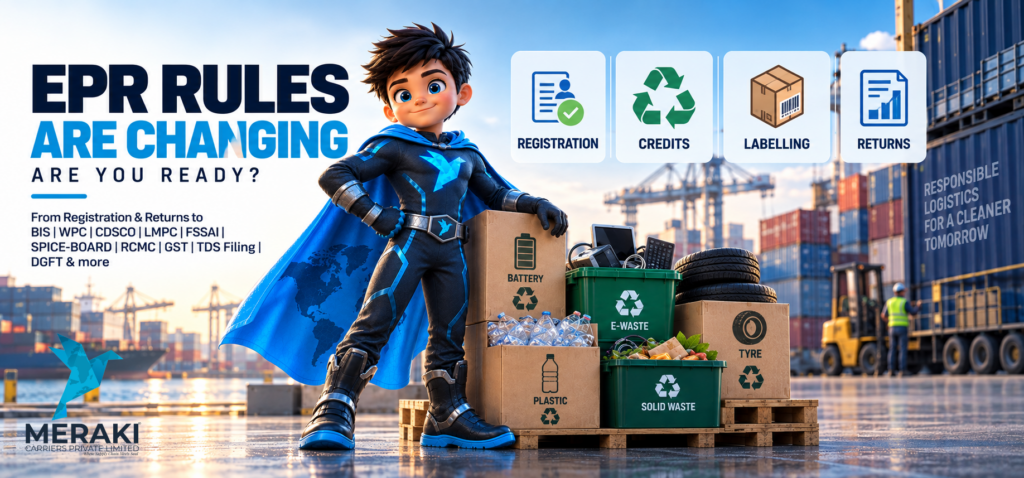
Captain Meraki’s message
Captain Meraki may look like a superhero.
But the real superpower here isn’t flying.
It is being prepared before the problem arrives.
Know what applies.
Know your numbers.
Know your deadlines.
Know your records.
Because compliance isn’t just about avoiding a last-minute problem.
It is about building a supply chain that is responsible for what it puts into the world.
Meraki Carriers Private Limited
Where Supply Chain Meets Soul.
Important note
EPR applicability and obligations vary by product, material, business role and the specific rules applicable to the entity. This article is intended as a general awareness guide and should not be treated as a substitute for reviewing the applicable legislation, CPCB/MoEFCC notifications or obtaining professional regulatory advice. Current deadlines and portal requirements should be verified before filing.
Sources: CPCB Common EPR Portal, CPCB Plastic EPR Portal, CPCB Battery EPR Portal, CPCB Waste Tyre EPR Portal and applicable EPR rules/guidelines.