
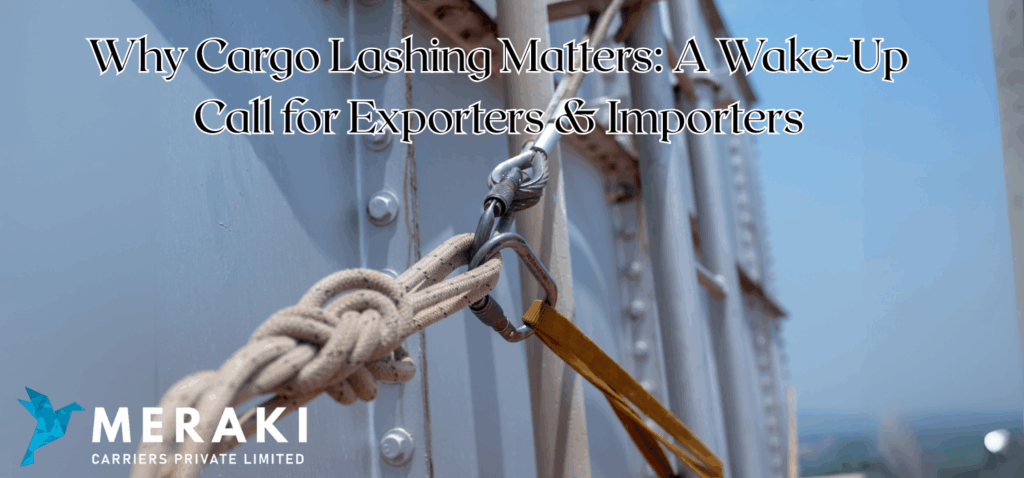
In the bustling world of international trade, Indian exporters and importers like you keep the economy moving. From Tirupur’s textile units to Moradabad’s metalware, your goods cross oceans, braving rough seas and unpredictable weather. But have you ever paused to ask: Is my cargo truly safe once it leaves port?
At Meraki Carriers, we recently came across a disturbing image—a rusted, poorly lashed container on a container ship. The securing bars were corroded, the lashings sloppy, and the entire stack looked dangerously unstable. It wasn’t just an eyesore—it was a stark warning.
This is not just a seafarer’s problem. It’s your cargo, your reputation, and your bottom line at stake.
🌊 The Ocean is Unforgiving—Why Cargo Lashing is Crucial
The seas aren’t gentle. Strong winds, high waves, and sudden storms can jolt even the largest vessels. If a container isn’t properly secured, it can shift, topple, or even fall overboard—taking your products and profits with it.
📦 One loose box can unbalance a stack.
⚠️ One unstable stack can damage dozens of containers.
🚢 And in worst cases, it can cause a ship to list, or even capsize.
🚨 The Real Cost of Negligence
- Financial Loss: Damaged or lost goods lead to insurance claims, delays, and frustrated overseas buyers.
- Human Risk: Crew members are often injured when trying to handle unstable cargo mid-sea.
- Environmental Harm: Containers falling into the ocean may contain hazardous goods, harming marine life and polluting international waters.
📘 The Role of Cargo Securing Manuals (CSMs)
Every ship has a Cargo Securing Manual tailored to its design. These manuals give precise instructions on how to lash different cargo types for different routes and weather conditions. But they’re only effective if followed properly.
Unfortunately, what we’re seeing far too often—especially in budget carriers or non-compliant vessels—is negligence or lack of training.
👷♂️ Untrained Crew = Exporter’s Nightmare
When you work with a freight forwarder or shipping partner who doesn’t prioritize seamanship, you’re essentially gambling with your cargo.
A crew member unfamiliar with lashing procedures is not just inefficient—they’re a liability.
That’s why at Meraki Carriers, we go beyond just documentation and booking space. We ensure your cargo is loaded, lashed, and monitored with global safety standards in mind.
✅ What You Can Do as an Exporter/Importer
Ask the Right Questions: Before shipping, ask your freight partner how cargo lashing is handled.
Choose Verified Partners: Don’t go by price alone—look for logistics providers with proven expertise.
Insist on Inspections: For high-value cargo, ask for loading supervision or third-party inspection at port.
Invest in Marine Insurance: Always protect against unforeseen loss during transit.
📣 Let’s Raise the Bar—Together
Poor lashing isn’t a technical error—it’s a warning sign of poor seamanship and management. And in a global market where Indian goods are gaining demand, we must ensure they arrive intact and on time.
At Meraki Carriers, we believe every exporter deserves peace of mind—knowing their cargo is not just moving, but moving safely.
🛡️ Proper lashing is not optional. It’s your first defense.
💡 Seamanship must evolve with trade.
🌍 Because one container lost is one too many.
🔗 Let’s Secure Your Next Shipment Right
📞 +91 8122037781
📧 info@merakicarriers.in
🌐 www.merakicarriers.in
Meraki Carriers Private Limited – Your Next Door Logistician
CargoSafety #IndianExporters #LogisticsIndia #SeaFreight #FreightForwarding #CargoLashing #MaritimeSafety #MerakiCarriers #GlobalTrade #ExportFromIndia #ImportToIndia #MarineLogistics #SupplyChainIndia #CSM #SeamanshipMatters #OceanFreightIndia